

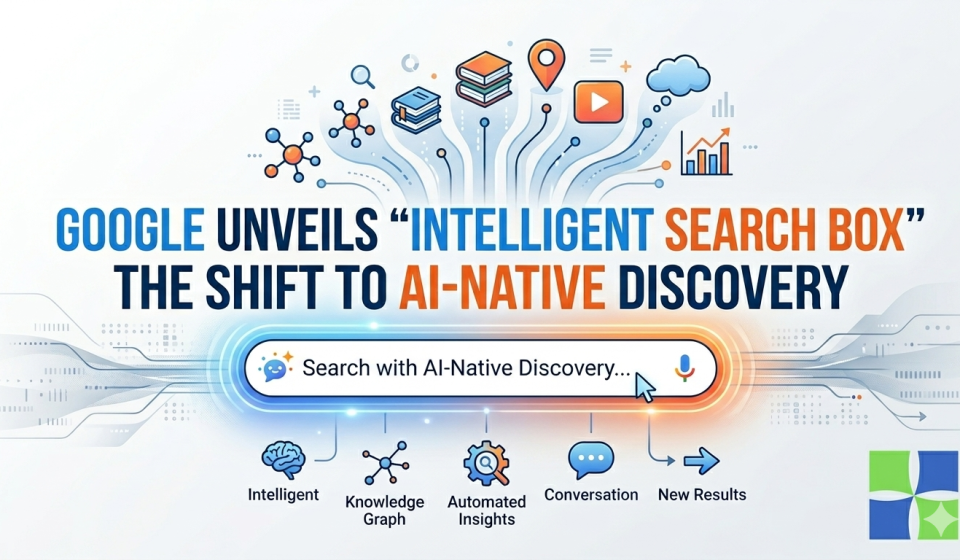
Google has rolled out its most radical interface transformation in a quarter of a century by introducing the Intelligent Search Box. Powered by Gemini 3.5 Flash, this update officially transitions Google from a traditional query-and-response search engine into an interactive AI discovery hub.
The redesign scraps the classic, static search bar in favor of an expansive, fluid canvas built to handle complex, multi-modal prompts.
Table of Contents
Key Features of the Intelligent Search Box
- Dynamic Canvas Expansion: The interface physically expands as you type, accommodating conversational, long-tail prompting rather than fragmented keywords.
Predictive Intent Suggestion: Moving far beyond basic autocomplete, the system uses contextual AI to anticipate your broader research goals.
Universal Multi-Modal Inputs: Users can seamlessly blend text, images, document files, video, and active Chrome tabs into a single prompt.
Global AI Mode Integration: The seamless transition from traditional search results to an immersive "AI Mode" is now live worldwide across both desktop and mobile layouts.
New Insights: The Strategic Impact on Digital Ecosystems
While this update focuses on user experience, the underlying implications for businesses, content creators, and SEO professionals are massive:
The Rise of Agentic Workflows:
As Sundar Pichai noted, search is evolving from one-off questions into ongoing conversations and multi-step tasks. Users are no longer just looking for a link; they are looking for an AI agent to execute a workflow (e.g., "Compare these three open tabs, find the best price, and draft a summary").
The "Zero-Click" Surge:
By making AI Overviews and AI Mode the default pathway, Google will resolve more user intents directly on the search page. Websites may see a drop in informational, top-of-funnel organic traffic.
A Shift in SEO Strategy:
Optimization is changing from "keyword matching" to AI Optimization (AIO). To win visibility, brands must ensure their data is highly structured, machine-readable, and authoritative enough to be cited inside Gemini's synthesized answers.

-

I Stop doing SEO cause doing SEO is no more worthy : Let’s do AEO

By
The Tactics of doing SEO have changed completely. And I bet you are doing it completely wrong. Have you ever imagined that you are purchasing…
📆
-

Google Antigravity: The Complete In-Depth Guide (2026)

By
Google Antigravity launched in November 2025 as one of the most ambitious bets yet in the "agentic coding" race, a category that also includes Cursor,…
📆
-

OpenAI Agent Builder: The Complete In-Depth Guide (2026)
By
Important Update Before You Read Further On June 3, 2026, OpenAI announced it is winding down Agent Builder, along with the Evals platform, with both…
📆
-

Website Conversion Optimization Tools: The Complete 2026 Guide
By
Why This Topic Matters Right Now Website Conversion Optimization Tools are the typical website converts in somewhere between roughly 2% and 5% of its visitors,…
-

How to Monetize a Niche Blog or Content Website
By
Most niche blogs fail to make money for one simple reason: they try every monetization method at once instead of matching the right method to…
📆
-

Scalable Business Ideas You Can Start Part-Time
By
Target Keyword Primary: scalable business ideas part-time Secondary: low-investment scalable business, part-time business that grows, side business with scale potential Why "Scalable" Matters More Than…
📆

Hi my name is Sanjivan, my nickname is Sanji. Business student who spends way too much time on the internet but make it productive.
I write about business, tech, AI, and marketing the stuff that's actually changing how the world works.
No fluff. No "guru" energy. Just real thoughts from someone still figuring it out. 😄


