

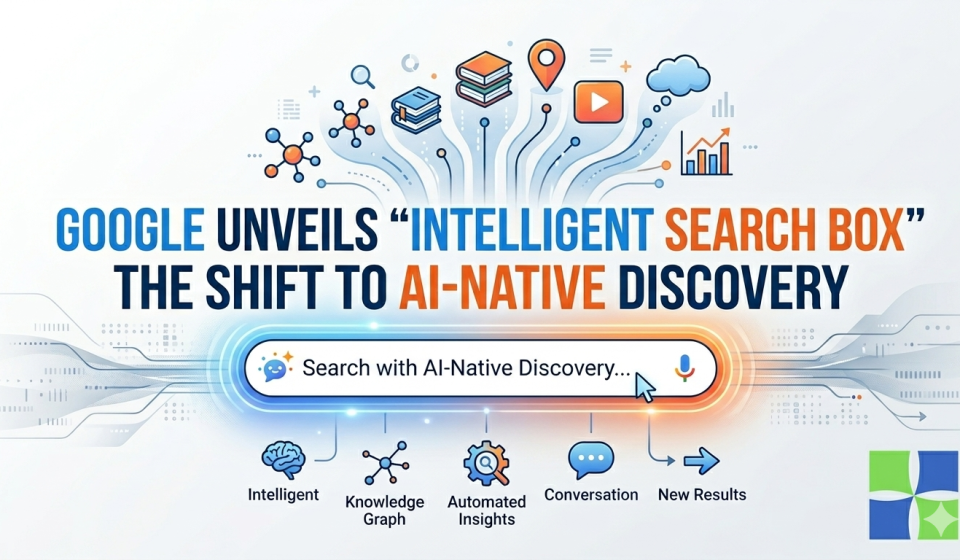
Google has rolled out its most radical interface transformation in a quarter of a century by introducing the Intelligent Search Box. Powered by Gemini 3.5 Flash, this update officially transitions Google from a traditional query-and-response search engine into an interactive AI discovery hub.
The redesign scraps the classic, static search bar in favor of an expansive, fluid canvas built to handle complex, multi-modal prompts.
Table of Contents
Key Features of the Intelligent Search Box
- Dynamic Canvas Expansion: The interface physically expands as you type, accommodating conversational, long-tail prompting rather than fragmented keywords.
Predictive Intent Suggestion: Moving far beyond basic autocomplete, the system uses contextual AI to anticipate your broader research goals.
Universal Multi-Modal Inputs: Users can seamlessly blend text, images, document files, video, and active Chrome tabs into a single prompt.
Global AI Mode Integration: The seamless transition from traditional search results to an immersive "AI Mode" is now live worldwide across both desktop and mobile layouts.
New Insights: The Strategic Impact on Digital Ecosystems
While this update focuses on user experience, the underlying implications for businesses, content creators, and SEO professionals are massive:
The Rise of Agentic Workflows:
As Sundar Pichai noted, search is evolving from one-off questions into ongoing conversations and multi-step tasks. Users are no longer just looking for a link; they are looking for an AI agent to execute a workflow (e.g., "Compare these three open tabs, find the best price, and draft a summary").
The "Zero-Click" Surge:
By making AI Overviews and AI Mode the default pathway, Google will resolve more user intents directly on the search page. Websites may see a drop in informational, top-of-funnel organic traffic.
A Shift in SEO Strategy:
Optimization is changing from "keyword matching" to AI Optimization (AIO). To win visibility, brands must ensure their data is highly structured, machine-readable, and authoritative enough to be cited inside Gemini's synthesized answers.

-

Website Conversion Optimization Tools: The Complete 2026 Guide

By
Why This Topic Matters Right Now Website Conversion Optimization Tools are the typical website converts in somewhere between roughly 2% and 5% of its visitors,…
-

How to Monetize a Niche Blog or Content Website

By
Most niche blogs fail to make money for one simple reason: they try every monetization method at once instead of matching the right method to…
📆
-

Scalable Business Ideas You Can Start Part-Time
By
Target Keyword Primary: scalable business ideas part-time Secondary: low-investment scalable business, part-time business that grows, side business with scale potential Why "Scalable" Matters More Than…
📆
-

AI-Based Search Visibility Software with Competitor Benchmarking
By
What Is AI Search Visibility Software? If you've ever searched your brand name inside ChatGPT or Perplexity and felt a small jolt of anxiety wondering…
📆
-

Crawling and Indexing: 10 Essential Tips to Rank Faster

By
Crawl and indexing issues stopping Google from finding your pages? Follow these 10 proven steps to get indexed faster and rank higher. If your pages…
-

Claude Opus 4.8 vs. ChatGPT 5.5: Which One Is Better?

By
The frontier AI landscape has reached an incredible peak with the releases of Anthropic’s Claude Opus 4.8 (released May 28, 2026) and OpenAI’s GPT 5.5…
📆

Hi my name is Sanjivan, my nickname is Sanji. Business student who spends way too much time on the internet but make it productive.
I write about business, tech, AI, and marketing the stuff that's actually changing how the world works.
No fluff. No "guru" energy. Just real thoughts from someone still figuring it out. 😄


