
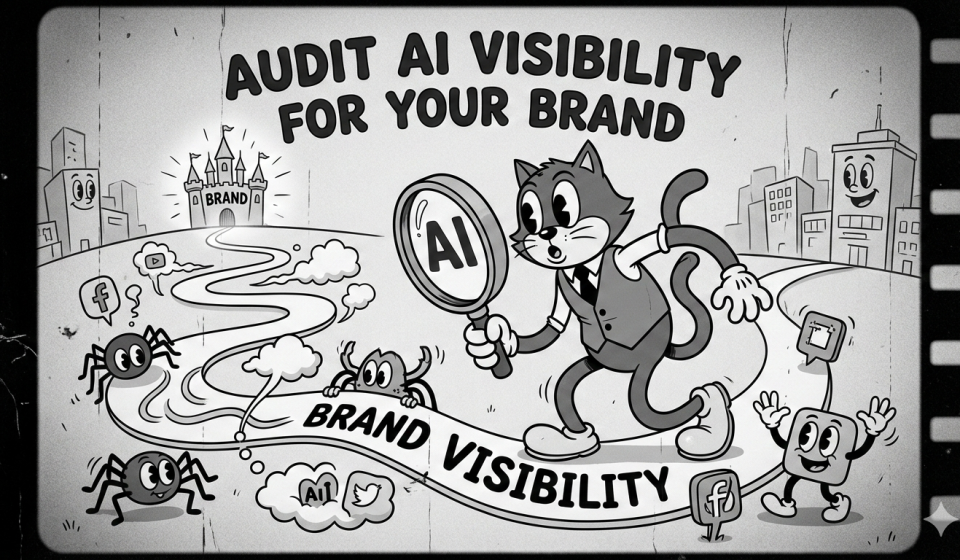

AI Visibility is one of the prominent topic to discuss. Every business in the world wants their brand listed in the AI Chat bot- ChatGPT, Gemini, Perplexity, Claude, and google overview. Many of the Top brands pays high to make there brand available in the AI. Many SEO expert and agency owner still don’t know the easiest way to check whether your brand is been cited on AI search or not.
Table of Contents
What is Audit AI visibility ?
A Audit AI visibility is a process to check whether your brand, content, and products are being cited and recommended across AI chatbots and search engines like ChatGPT, Google Gemini, Perplexity, and Claude. It helps you understand your presence in AI-powered search results and answer engines.

In this blog, you will learn the how to check the AI visibility Audit for your “brand”.
Check: AI tools for mobile search visibility
Quickest 4 steps your can Audit AI Visibility of your Brand
Step 1: Check AI Answers for Your Key Queries
Test 10-20 of your most important queries across platforms:
| Query | Google AI Overview | ChatGPT | Perplexity | You Cited? | Competitors Cited? |
| [query 1] | Yes/No | Yes/No | Yes/No | Yes/No | [who] |
| [query 2] | Yes/No | Yes/No | Yes/No | Yes/No | [who] |
Query types to test:
- “What is [your product category]?”
- “Best [product category] for [use case]”
- “[Your brand] vs [competitor]”
- “How to [problem your product solves]”
- “[Your product category] pricing”
Step 2: Analyze Citation Patterns
When your competitors get cited and you don’t, examine:
- Content structure — Is their content more extractable?
- Authority signals — Do they have more citations, stats, expert quotes?
- Freshness — Is their content more recently updated?
- Schema markup — Do they have structured data you’re missing?
- Third-party presence — Are they cited via Wikipedia, Reddit, review sites?
Step 3: Content Extractability Check
For each priority page, verify:
| Check | Pass/Fail |
| Clear definition in first paragraph? | |
| Self-contained answer blocks (work without surrounding context)? | |
| Statistics with sources cited? | |
| Comparison tables for “[X] vs [Y]” queries? | |
| FAQ section with natural-language questions? | |
| Schema markup (FAQ, HowTo, Article, Product)? | |
| Expert attribution (author name, credentials)? | |
| Recently updated (within 6 months)? | |
| Does the heading structure match query patterns? | |
| Are AI bots allowed in robots.txt? |
Step 4: AI Bot Access Check
Verify your robots.txt allows AI crawlers. Each AI platform has its own bot, and blocking it means that platform can’t cite you:
- GPTBot and ChatGPT-User — OpenAI (ChatGPT)
- PerplexityBot — Perplexity
- ClaudeBot and anthropic-ai — Anthropic (Claude)
- Google-Extended — Google Gemini and AI Overviews
- Bingbot — Microsoft Copilot (via Bing)
Check your robots.txt for Disallow rules targeting any of these. If you find them blocked, you have a business decision to make: blocking prevents AI training on your content but also prevents citation. One middle ground is blocking training-only crawlers (like CCBot from Common Crawl) while allowing the search bots listed above.
Cited your brand in AI overview
Frequently Asked Question
1. What is Audit AI visibility ?
A Audit AI visibility is a process to check whether your brand, content, and products are being cited and recommended across AI chatbots and search engines like ChatGPT, Google Gemini, Perplexity, and Claude. It helps you understand your presence in AI-powered search results and answer engines.
2. Why is AI visibility important for SEO?
AI visibility is critical because AI-powered answer engines are becoming the primary way users find information. Being cited by AI models drives brand authority, increases website traffic through AI recommendations, and improves your overall online visibility in the AI era of search.
3. How do I check if my brand is cited in AI search results?
Follow the 4-step method: (1) Test 10-20 priority queries in ChatGPT, Gemini, Perplexity, and Google AI Overview. (2) Analyze citation patterns against competitors. (3) Check your content extractability for AI. (4) Verify your robots.txt allows AI bot access.
4. What queries should I test for AI visibility?
Test these query types: (1) ‘What is [your product]?’ (2) ‘Best [product] for [use case]’ (3) ‘[Your brand] vs [competitor]’ (4) ‘How to [problem your product solves]’ (5) ‘[Product] pricing’. These represent the most common AI-answered queries.
5. What are AI citation patterns and why do they matter?
Citation patterns show which competitors rank in AI answers and why. Analyze their content structure, authority signals, freshness, schema markup, and third-party presence. Understanding these patterns helps you optimize your content for AI rankings.
6. What is content extractability and how does it affect AI rankings?
Content extractability measures how easily AI models can pull information from your pages. Use clear definitions, self-contained answer blocks, statistics with sources, comparison tables, FAQs, structured data (schema), expert attribution, fresh updates (within 6 months), and proper heading structure for better AI extractability.
7. Which AI bots do I need to allow in robots.txt?
Allow these AI bots: GPTBot & ChatGPT-User (OpenAI), PerplexityBot (Perplexity), ClaudeBot & anthropic-ai (Anthropic), Google-Extended (Google Gemini/AI Overview), Bingbot (Microsoft Copilot). Blocking them prevents both AI training on your content AND citation in AI results.
8. Should I block AI bots in robots.txt?
It depends on your strategy. Blocking prevents AI training on your content but also prevents AI citations. A middle ground: allow search-and-citation bots (GPTBot, PerplexityBot, etc.) but block training-only crawlers (CCBot from Common Crawl). This balances visibility with content protection.
9. What schema markup do I need for AI visibility?
Implement: FAQ schema (for Q&A content), HowTo schema (for instructional content), Article schema (for blog posts), Product schema (for product pages), and Organization schema (for brand authority). Structured data helps AI models understand and extract your content more accurately.
10. How often should I audit AI visibility?
Conduct AI visibility audits quarterly (every 3 months) to track changes in citation patterns, monitor competitor performance, and adjust your AI SEO strategy. Monthly checks are recommended for high-priority keywords targeting your top markets.

Hi my name is Sanjivan, my nickname is Sanji. Business student who spends way too much time on the internet but make it productive.
I write about business, tech, AI, and marketing the stuff that's actually changing how the world works.
No fluff. No "guru" energy. Just real thoughts from someone still figuring it out. 😄


