

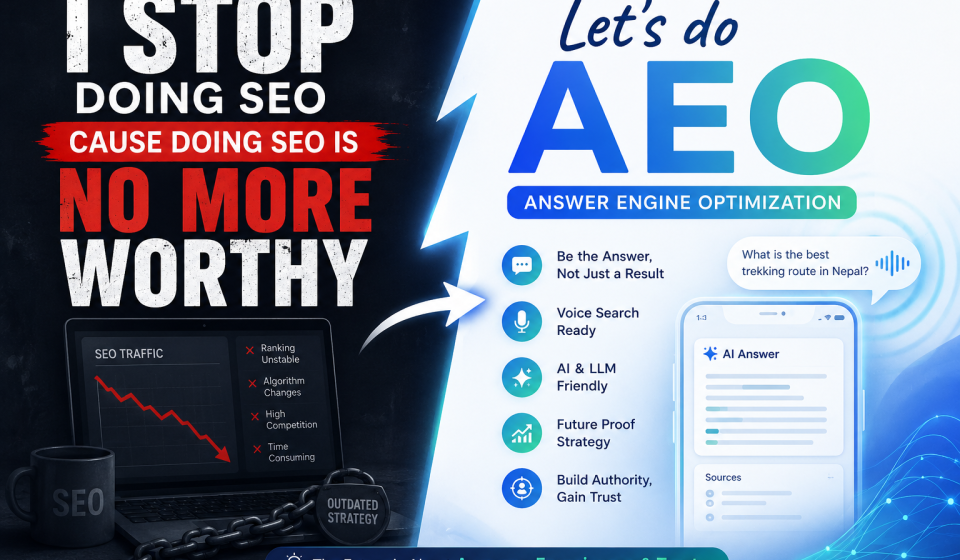
The Tactics of doing SEO have changed completely. And I bet you are doing it completely wrong. Have you ever imagined that you are purchasing AI tools for keyword research that won’t work any more. Have you ever noticed that your clicks and visitors are dropping day by day ? This is all because of the industry shift into the era of AI. Fact : You can hold the top spot and still lose 60% of your traffic to AI Overviews.If your organic traffic is dropping despite “good rankings,” you’re making one of these 3 critical mistakes in the AI era.
Table of Contents
If you are still wondering about how to get more visitors and the click in the site then here we have to understand what Google is saying. Let’s Understand it by in the form of Chapter
Chapter : 1 Understand the Key Concepts & Insights
1. The Death of Keyword Matching
Traditional vs. Modern SEO : In Traditional SEO we google in the AI search tools like Ahref and semrush and search for the keyword, which they provide the keyword which we match and write in our blog post content. Which ultimately pushes on #1 in Google and we get more visitors and clicks. But in Modern SEO, google says it all, it’s about the Keyword, it’s about the user intended for searching. Let me give you an example of how Traditional SEO and How is Modern SEO working

From Keywords to Intent: Traditional SEO vs. Modern SEO

In Modern SEO, the goal isn’t matching the keyword, it’s answering the question behind it. When someone searches ‘best running shoes for flat feet,’ they don’t want ten blue links to click through. They want a direct, conversational answer that solves their problem right there, instantly — no digging required.
How it plays out with your example:
Traditional: keyword “best running shoes” gets matched → you write a generic “Top 10 shoes” listicle → it ranks as one of ten blue links → the user has to click and scan to find what actually fits flat feet.
Modern: the real intent is arch support and pain relief → you write content that explains why certain shoes help flat feet and then recommends them → it gets pulled into an AI Overview or featured snippet → the user gets the answer on the spot, no click needed.
2. Zero-Click Searches: Even before AI Overviews launched, 57% of searches ended without a single click

That visual makes the point sharper than any stat sheet could: even before AI Overviews existed, more than half of all Google searches (57%) ended with the user getting what they needed right on the results page: no click, no website visit, nothing for you to capture as “traffic.”
That’s the real argument for your pitch: ranking #1 in the old sense was already losing relevance before AI search accelerated it. AI Overviews didn’t create the zero-click problem, they just made it bigger. This is a strong data point to pair with your Traditional vs Modern SEO diagram in a client deck, since it backs up why chasing keyword rank alone isn’t the win it used to be.
3. Impact of AI Overviews: When an AI Overview appears above search results, the click-through rate (CTR) for the #1 ranking spot can drop significantly (e.g., from 1.76% down to 0.61%)

Chapter 2 There is a 4 state of people Mind
The 4 state of people mind are given below :
- Want to know
- Want to go
- Want to do
- Want to buy

Google says these are the 4 states of people’s minds. If you track their behavior you will crack the search intended and their actual problems. Let’s understand each of them with clear answers.
1. Want to Know — research mode
The person isn’t ready to act yet, they want to understand. “Benefits of drinking warm water in the morning” is someone learning the mechanism, not shopping. Content should answer the “why” and “how” directly, in plain sentences an AI can lift as-is.
2. Want to Go — location intent
“Best trekking agency near me” isn’t a research question, it’s a decision about where. Google needs your business tied to a place, hours, and proximity not just good content
3. Want to Do — problem-solving mode
“How do I fix knee pain when I run?” is a person’s mid-problem, wanting a fix, not theory. Structure the answer as clear steps that’s what HowTo schema is built to expose to AI answers.
4. Want to Buy — purchase-ready
“Best trekking gear for Langtang Valley trek” is in comparison mode. The person has narrowed down to a category and wants specifics before they pay. Product schema surfaces price, rating, and availability directly in the AI answer.
Chapter 3. Conversational Searches vs. Traditional Keywords
Search behavior is changing.
People are no longer limited to typing short, fragmented keywords such as:
“Langtang trek cost”
Instead, they are increasingly describing their complete situation, context, requirements, and expectations:
“How much should I budget for a 7-day Langtang Valley Trek from Kathmandu, including accommodation, food, permits, and transportation?”
The second query contains much more information about what the person actually wants.
This is the shift from keyword search → conversational search.
Traditional Search: “Give Me a Keyword”
Traditional search behavior often looks like this:
User thinks about a topic
↓
Breaks it into a few keywords
↓
Types 1–3 words
↓
Searches
For example:
“Langtang trek cost”
The search engine has to interpret what the user means.
Does the user want:
Trekking package prices?
Daily expenses?
Transportation costs?
Permit costs?
Food costs?
Guide costs?
Accommodation costs?
The keyword gives the topic, but not the complete situation.
Conversational Search: “Here Is My Situation”
Conversational search is different.
The user explains what they are actually trying to accomplish.
For example:
“I am planning a 7-day Langtang Valley Trek from Kathmandu with a budget of Rs. 50,000. What should I expect to spend on permits, accommodation, food, transportation, and a guide?”
Now the search contains:
Topic + Situation + Goal + Constraints + Questions
That gives an AI system much more context to work with.
The conversational search structure
Situation
↓
Problem / Goal
↓
Context
↓
Constraints
↓
Specific Question
↓
Expected Answer
This is why conversational queries are becoming increasingly important for GEO.
Why Long Queries Matter
A short keyword might tell a search engine what the topic is.
A conversational query can tell an AI system:
“What does this person actually need?”
Compare these two searches:
Short query
“SEO agency Nepal”
Intent is unclear.
The user might want:
SEO services
SEO pricing
SEO jobs
SEO agencies
SEO courses
SEO information
Conversational query
“I run a small ecommerce business in Nepal and want to increase organic traffic without spending heavily on paid ads. Which SEO services should I prioritize?”
Now the context is much clearer.
The user has provided:
Business type
Location
Objective
Constraint
Problem
Expected solution
The AI can therefore provide a much more targeted answer.
The Data Signal
One commonly cited trend is that short queries of 1–3 words trigger AI Overviews less frequently than longer queries. The figures you provided 23% for 1–3-word queries versus 77% for 6+ word queries illustrate the broader point: longer, more specific searches tend to provide richer context for AI-generated answers.
Similarly, the 76% conversational-search preference figure can be used as a directional signal that users increasingly value getting a direct, contextual answer rather than manually opening and comparing multiple search results.
For published content, however, treat these percentages as source-dependent statistics rather than universal Google rules. Search behavior and AI-result frequency change over time.
Keywords Are Not Dead — Their Role Is Changing
This doesn’t mean keywords no longer matter.
They still help search engines understand:
What is this page about?
But conversational search adds another layer:
Why does the user want this information?
Think about it this way:
Traditional SEO
Keyword → Topic
Modern SEO + GEO
Keyword → Topic → Context → Intent → Problem → Answer
The keyword gets you into the conversation.
The context helps you answer the conversation.
The Conversational Search Workflow
A useful way to understand this change is:
Traditional
Keyword
↓
Search Results
↓
User opens multiple pages
↓
User compares information
↓
User finds an answer
Conversational
Situation
↓
Natural-language question
↓
AI understands context
↓
AI synthesizes relevant information
↓
Direct answer
↓
Follow-up question
↓
Deeper conversation
This last step is particularly important.
A user may begin with:
“Best trekking agency in Nepal”
Then continue:
“Which one is best for Langtang?”
Then:
“What is the price for 7 days?”
Then:
“Does the package include a guide?”
The search journey becomes a conversation, not a collection of isolated keywords.
Chapter 4. Google Rankings vs. AI Visibility
For years, SEO had a simple objective:
Rank #1 on Google.
The higher your page ranked, the more visibility you expected to receive.
But AI search is changing the game.
When someone asks ChatGPT, Gemini, Google AI Overviews, Perplexity, or another AI search engine a question, the system doesn’t simply return a list of blue links.
It may:
Understand the user’s question
Search across multiple sources
Compare information
Extract relevant passages
Synthesize an answer
Cite the sources it considers useful
This creates a new SEO question:
“Can my content be discovered, understood, selected, and cited by AI?”
That is the difference between Google Rankings and AI Visibility.
Traditional SEO: Position Is the Goal
Traditional SEO generally works around a ranking model:
Search Query
↓
Google Crawls Pages
↓
Google Evaluates Relevance + Quality + Authority
↓
Pages Are Ranked
↓
User Clicks a Result
The objective is therefore:
Get into the top 10.
For example:
“Best trekking agency in Nepal”
A traditional SEO strategy might focus on getting the page into:
Position #1 → Position #3 → Position #5
The higher the ranking, the more opportunities for clicks and impressions.

AI Search: Citation Is the New Opportunity
AI search introduces another layer.
Imagine someone asks:
“What is the best time to visit Nepal for trekking?”
An AI system may answer the question directly and cite several sources.
Your website might appear:
not at position #1 in Google,
but as one of the sources supporting the AI-generated answer.
That means your visibility is no longer determined only by:
Where do I rank?
It can also depend on:
Can an AI system find, understand, trust, and use my information?
The Interesting Data Signal
Research cited in discussions around AI search has suggested that traditional Google rankings and AI citations do not always overlap.
For example, the figures you provided suggest:
A #1 Google ranking may have only around a 31.4% chance of being cited in an AI Overview.
One study reported that 90% of pages cited by AI models ranked #21 or lower in standard Google results.
Another reported that around 75% of AI-engine citations came from sources outside Google’s top 10 results.
These numbers should be treated as study-specific findings, not permanent rules of how every AI search engine works.
But the strategic lesson is important:
Ranking highly on Google and being visible inside AI-generated answers are related, but they are not the same objective.
Why Can This Happen?
Because AI systems can evaluate information differently from a traditional search-results page.
Consider two websites.
Website A
Ranks:
#2 on Google
But its content is:
Generic
Poorly structured
Difficult to extract information from
Missing specific answers
Weak on supporting evidence
Website B
Ranks:
#35 on Google
But its content contains:
Specific answers
Original research
First-hand experience
Clear explanations
Useful statistics
Structured information
Strong topical relevance
An AI system may find Website B useful for answering a specific question.
Therefore:
Google position ≠ guaranteed AI citation
The New Visibility Funnel
Traditional SEO can be simplified as:
Crawl
↓
Index
↓
Rank
↓
Click
But AI visibility adds another layer:
Crawl
↓
Understand
↓
Retrieve
↓
Evaluate
↓
Select
↓
Cite
↓
User sees the source
This changes how we think about optimization.
Ranking vs. Citation
Traditional SEO
AI / GEO Visibility
Rank higher
Become a useful source
Target keywords
Target questions and entities
Optimize for SERPs
Optimize for answer retrieval
Focus on position
Focus on inclusion
Get clicks
Get cited / mentioned
Build backlinks
Build authority + evidence
Match search terms
Match user context
Optimize pages
Build comprehensive topical coverage
The two approaches aren’t enemies.
Good GEO builds on strong SEO fundamentals.
What Makes Content More Citation-Worthy?
If you want AI systems to reference your content, don’t simply write longer articles.
Make the information useful, specific, and easy to verify.
Focus on:
1. Direct Answers
Answer the question clearly.
Don’t hide the answer underneath five paragraphs of introduction.
2. Original Information
AI systems have access to enormous amounts of repeated information.
If your page simply rewrites what everyone else says, it gives the AI little reason to prefer your source.
Original information can include:
Research
Data
Surveys
Experiments
First-hand experience
Case studies
Expert commentary
Original comparisons
3. Specific Facts
Instead of:
“The trek can be expensive.”
Give useful details:
“A 7-day Langtang Valley Trek typically requires budgeting for transportation, accommodation, meals, permits, guide services, and personal expenses.”
Specific information is easier to use in an answer.
4. Clear Structure
Use:
Question → Answer → Explanation → Evidence → Example
This makes the relationship between the question and answer obvious.
5. Trust Signals
Make it clear:
Who wrote the content?
What experience do they have?
Where did the information come from?
When was it updated?
Is the information supported by reliable sources?
Think Beyond the Top 10
This is one of the biggest mindset changes in GEO.
Traditional SEO asks:
“How do I get into Google’s top 10?”
GEO asks:
“How do I become one of the best sources for this question?”
Those questions overlap, but they aren’t identical.
Your target should therefore be:
Search visibility + AI visibility + brand visibility
rather than rankings alone.
Example: Travel Website
Imagine you operate a Nepal trekking website.
You want to rank for:
“Langtang Valley Trek”
Traditional SEO might focus on:
Keyword optimization
Backlinks
Page speed
Internal linking
Title tags
Meta description
Content length
These remain important.
But GEO adds questions such as:
“What does the trek actually cost?”
“How difficult is Langtang Valley Trek?”
“What should beginners know before going?”
“What permits are required?”
“How many days should I spend?”
“What should I pack?”
“What is the best month?”
Now you’re building a knowledge source, not just a ranking page.
The GEO Content Strategy
Think of your content as a database of answers.
Main Topic
Langtang Valley Trek
↓
Questions
Cost
Difficulty
Duration
Permits
Transportation
Accommodation
Food
Weather
Packing
Safety
↓
Detailed Answers
↓
Supporting Evidence
↓
First-hand Experience
↓
AI-readable information
↓
Potential citation
This is much more powerful than repeating:
“Langtang Valley Trek”
50 times throughout an article.
The New SEO Question
The old question:
“Why isn’t my page ranking #1?”
The new question:
“Why isn’t my information being selected when AI answers this question?”
That leads to better optimization decisions.
You can investigate:
Is the answer actually clear?
Is the information unique?
Is there stronger evidence elsewhere?
Are competitors providing better first-hand information?
Does the page answer the complete question?
Is the source trustworthy?
Is the information easy to extract?
Are important claims supported?
Google Ranking Still Matters
Don’t misunderstand the shift.
GEO does not mean SEO is dead.
Search engines and AI systems still rely heavily on discoverable, useful, authoritative web content.
Technical SEO remains important:
Crawling
Indexing
Internal linking
Page experience
Structured data
Content quality
Authority
Relevant backlinks
The difference is that ranking is no longer the only visibility metric worth thinking about.
The New Visibility Model
Think about modern search visibility as three layers:
Layer 1 — Search Ranking
Can people find you in traditional search?
↓
Layer 2 — AI Citation
Can AI systems use your information to answer questions?
↓
Layer 3 — Brand Recognition
Does the user recognize and trust your brand after seeing the answer?
The strongest strategy works toward all three.
Remember This
Traditional SEO
“Rank me.”
GEO
“Understand me.”
AI Search
“Use me when I provide the best answer.”
So don’t stop at:
“I want to rank #1.”
Start asking:
“I want my information to become a trusted source that search engines and AI systems can discover, understand, and reference.”
That is the shift from Google Ranking → AI Visibility.
Chapter 5. How to Get Cited by AI: An Actionable GEO Framework
Getting your content cited by AI search engines isn’t simply about ranking higher on Google.
The bigger objective is to make your information:
Discoverable → Understandable → Relevant → Trustworthy → Citation-worthy
A practical GEO strategy can be divided into two major areas:
1. On-Page Optimization — 25%
Make your content easy for AI systems to understand, extract, and connect with specific questions.
2. Off-Page Presence — 75%
Build the authority, mentions, references, and external presence that help establish your website as a credible source.
Think of it this way:
On-page optimization tells AI what you know.
Off-page presence helps demonstrate why your information should be trusted.

Part 1: On-Page Optimization
1. Lead With the Direct Answer
One of the simplest GEO improvements is also one of the most important:
Answer the question first.
Don’t make the user or AI system search through a long introduction to find the actual answer.
Weak structure
What is Langtang Valley Trek?
Nepal is a beautiful country known for its mountains, culture, traditions, landscapes, and incredible trekking opportunities. Every year, thousands of tourists visit Nepal…
The actual answer may appear several paragraphs later.
Better structure
What is Langtang Valley Trek?
Langtang Valley Trek is a popular Himalayan trek in Nepal that takes travelers through the Langtang region, combining mountain scenery, Tamang culture, forests, and high-altitude landscapes.
Then explain the details.
The GEO structure
Question
↓
Direct Answer
↓
Explanation
↓
Supporting Details
↓
Example / Evidence
This makes the answer easier for both humans and AI systems to identify.
The rule
Don’t start with:
“In today’s rapidly changing world…”
Start with:
“The answer is…”
Or simply give the answer.
2. Use Real Prompts as Headings
Your headings shouldn’t only describe the topic.
They should reflect the questions people actually ask.
Instead of:
Langtang Trek Cost
Use:
How Much Does the Langtang Valley Trek Cost?
Instead of:
Trek Difficulty
Use:
How Difficult Is the Langtang Valley Trek?
Instead of:
Best Time
Use:
What Is the Best Time to Trek Langtang Valley?
Why?
Because conversational search increasingly happens through complete questions.
A question-based heading creates a clear relationship:
User Question → Heading → Answer
That makes the page easier to navigate for users and easier to interpret as a collection of question-answer relationships.
3. Build Intent-Based FAQs
Don’t create FAQs simply because:
“Every SEO article needs an FAQ section.”
Instead, build FAQs around the actual questions surrounding the topic.
Suppose your primary topic is:
Langtang Valley Trek
Your question research might reveal:
How difficult is Langtang Valley Trek?
How many days does Langtang Valley Trek take?
How much does Langtang Valley Trek cost?
What permits are required?
Is Langtang Valley Trek suitable for beginners?
What should I pack?
What is the best month to go?
Do I need a guide?
How do I get to Langtang Valley from Kathmandu?
These questions can become an intent-based FAQ cluster.
Instead of:
FAQ
What is Langtang Valley Trek?
How much does it cost?
Is it difficult?
You can organize the questions according to the user’s journey:
Planning
How many days should I plan for Langtang Valley Trek?
Cost
How much does Langtang Valley Trek cost?
Difficulty
How difficult is Langtang Valley Trek?
Preparation
What should I pack for Langtang Valley Trek?
Logistics
How do I get from Kathmandu to Langtang Valley?
Now the FAQ isn’t just a collection of random questions.
It represents the user’s decision journey.
Where Do You Find These Questions?
You can collect real-world questions from sources such as:
Google autocomplete
People Also Ask
Reddit discussions
YouTube comments
Customer questions
Sales conversations
Search Console queries
Keyword research tools
AnswerThePublic
AI conversations
Competitor FAQ sections
The objective isn’t to collect hundreds of questions.
The objective is to discover:
“What are people actually trying to understand or accomplish?”
The Question Cluster Method
Here’s a simple GEO workflow.
Step 1 — Choose your primary topic
Example:
Langtang Valley Trek
↓
Step 2 — Collect real questions
Example:
How much does it cost?
How difficult is it?
How long does it take?
What permits do I need?
What should I pack?
↓
Step 3 — Group questions by intent
Cost
Difficulty
Duration
Permits
Packing
Transportation
Safety
↓
Step 4 — Create direct answers
Answer each question clearly.
↓
Step 5 — Add supporting information
Provide:
Examples
Data
Experience
Sources
Explanations
Comparisons
↓
Step 6 — Connect related questions
Use internal links to create a broader topical network.
The GEO Answer Block
A useful format for AI-oriented content is the Answer Block.
For every important question, try to create this structure:
Question
How difficult is the Langtang Valley Trek?
Direct answer
Langtang Valley Trek is generally considered a moderate trek, but difficulty varies depending on altitude, daily walking distance, weather, and individual fitness.
Supporting explanation
Explain:
Daily walking hours
Elevation
Terrain
Altitude gain
Weather
Fitness requirements
Practical recommendation
Explain who the trek is suitable for and what preparation is useful.
This gives the page a clean information hierarchy.
Don’t Write for AI — Write for Answers
There is an important distinction here.
You don’t want to create unnatural content like:
“Langtang Valley Trek best Langtang Valley Trek cost Langtang Valley Trek difficulty…”
That is keyword stuffing.
Instead, write naturally:
How much does Langtang Valley Trek cost?
The total cost depends on the duration, group size, transportation, accommodation, food, permits, guide services, and other inclusions. A typical package can therefore vary considerably depending on the services selected.
The content is written for the human first, but structured clearly enough for machines to understand.
A Simple On-Page GEO Checklist
Before publishing an article, ask:
Direct Answers
☐ Does every major question receive a clear answer?
☐ Is the answer presented near the beginning of the relevant section?
Headings
☐ Do my headings reflect real user questions?
☐ Have I included conversational queries?
FAQs
☐ Did I research real questions?
☐ Are my FAQs connected to the main topic?
☐ Do they represent different search intents?
Content
☐ Is the information specific?
☐ Have I removed unnecessary introductions and filler?
☐ Have I included examples and supporting evidence?
Structure
☐ Can someone quickly scan the page and find the answer?
☐ Are related questions logically grouped?
☐ Are important pages connected through internal links?
The 25% On-Page Principle
Think of on-page GEO as making your content machine-readable in meaning, not merely machine-readable in HTML.
Your goal is to make the relationship obvious:
Question
↓
Answer
↓
Explanation
↓
Evidence
↓
Related Question
When an AI system needs an answer to a particular question, it should be able to identify:
“This page directly answers that question.”
That is the foundation of citation-friendly content.
But On-Page Is Only Half the Story
Even excellent content doesn’t automatically become an AI citation.
You can have:
Excellent content
Perfect structure
Great answers
and still struggle to gain visibility.
Why?
Because AI systems don’t evaluate your page in isolation.
They can also consider information about your brand, website, authors, products, services, reputation, and presence across the wider web.
That brings us to the second part:
Off-Page Presence
On-page optimization makes your information easy to understand.
Off-page presence helps establish credibility and authority.
And this is where the larger 75% GEO effort comes into the framework.
Chapter 6. Off-Page Presence: The 75% GEO Strategy
Creating excellent content on your own website is only one part of GEO.
The second part is making sure your brand, expertise, products, and information exist across the wider web.
Why?
Because AI systems don’t learn about your brand from your website alone.
They can encounter information through:
Online communities
Review platforms
Third-party websites
Industry publications
Comparison articles
Forums
News websites
Business directories
Expert discussions
Social platforms
This is why off-page presence is an important part of an AI visibility strategy.
Your website tells AI what you say about yourself.
The wider web tells AI what other people say about you.
Why Off-Page Presence Matters for GEO
Traditional SEO often asks:
“How many websites link to me?”
GEO requires a broader question:
“Where is my brand being discussed, referenced, recommended, reviewed, or compared?”
Imagine two companies.
Company A
Has a beautiful website with 500 pages.
But almost nobody talks about the company anywhere else.
Company B
Has a smaller website.
But its brand appears across:
Industry discussions
Review websites
Community conversations
Comparison articles
Expert publications
Relevant directories
When an AI system is trying to understand which company is credible, Company B has a much larger web footprint.
This is sometimes described as digital presence or entity visibility.
The Off-Page GEO Framework
Think of off-page visibility as:
Brand
↓
Mentions
↓
Discussions
↓
Reviews
↓
Recommendations
↓
Third-Party References
↓
AI Discovery
↓
Potential Citation / Mention
The goal isn’t simply to collect backlinks.
The goal is to build a credible information ecosystem around your brand.
1. Reddit & Online Communities
Online communities can be valuable because they contain something traditional marketing often lacks:
Real conversations between real people.
People discuss:
Problems
Products
Services
Experiences
Recommendations
Complaints
Alternatives
Comparisons
Communities such as Reddit can therefore contain useful first-hand context about brands and products.
For example, imagine someone asks:
“What is the best inventory management software for a small retail business?”
The discussion might include:
Personal experiences
Recommendations
Problems with existing tools
Feature comparisons
Pricing opinions
Alternative solutions
That type of discussion can become useful contextual information for search and AI systems.
GEO strategy
Don’t treat communities as places to spam links.
Instead:
Find relevant conversations
↓
Understand the actual problem
↓
Provide useful information
↓
Share genuine experience
↓
Mention your solution only when genuinely relevant
The objective is to become:
A useful participant in the conversation.
Not:
A company dropping promotional links everywhere.
2. Review Platforms
Reviews create another layer of external brand information.
Depending on the industry, relevant platforms can include:
G2
Capterra
Trustpilot
Google Business Profile
Industry-specific review platforms
These platforms can contain information about:
Customer experience
Product quality
Service quality
Strengths
Weaknesses
Features
Support
Pricing
Reliability
This gives search and AI systems additional context about your business.
Example
Suppose an AI user asks:
“Which inventory management software is suitable for a small retail business?”
Your website may explain your features.
But external reviews can provide another layer:
“Customers say the system is easy to use for small businesses.”
Now the information isn’t coming only from the company itself.
It has independent context.
3. Third-Party Roundups
Another important source of external visibility is the third-party roundup.
These are articles such as:
“10 Best Inventory Management Software”
“Best SEO Tools for Small Businesses”
“Top Alternatives to Shopify”
“Best Trekking Agencies in Nepal”
“Best CRM Software for Startups”
These pages are valuable because they create a comparison context.
Instead of an AI system only finding:
Brand → Website
it may discover:
Brand → Website → Comparison → Competitors → Reviews → Recommendations
That creates a richer understanding of the entity.
Why “Best Of” Pages Matter
Imagine your company sells SEO software.
Your website says:
“We are one of the best SEO platforms.”
That’s a first-party claim.
Now imagine an independent publication writes:
“Here are the 10 best SEO platforms for small businesses.”
And your company appears in the list.
That’s a third-party reference.
The second signal can be more useful for understanding market positioning because the recommendation isn’t coming directly from the company.
This is why you should think beyond:
“How many backlinks do I have?”
and start thinking:
“How many relevant, credible places mention my brand in the context that matters?”
4. Industry Publications
Another powerful layer is getting your expertise mentioned by relevant publications.
For example, if you operate a digital marketing company, relevant external coverage could include:
Marketing publications
Business websites
Industry blogs
Technology publications
Expert interviews
Podcasts
Research reports
The important factor is relevance.
A mention on a completely unrelated website isn’t necessarily useful.
A relevant mention such as:
“Digital marketing expert explains how AI is changing search behavior”
creates much stronger topical context.
5. Expert Contributions
You can also build external authority by contributing your expertise.
Examples include:
Expert interviews
Guest articles
Podcast appearances
Industry panels
Original research
Expert quotes
Conference participation
Case studies
This creates a connection between:
Person → Expertise → Topic → Organization
That can strengthen the overall entity footprint.
6. Original Research
One of the strongest ways to create external visibility is to publish information that other websites actually want to reference.
For example:
Instead of writing:
“SEO is important for businesses.”
Conduct a survey:
“We analyzed 500 Nepalese ecommerce websites and found that 68% had no optimized product-category structure.”
Now you’ve created something other publishers can reference.
The process becomes:
Original Research
↓
Publish Findings
↓
Other Websites Discover It
↓
Journalists / Bloggers / Experts Reference It
↓
More Mentions
↓
More External Context
↓
Potential AI Discovery
This is much more powerful than simply publishing another generic article.
7. Build a Web of Evidence
Think about your brand as an entity that exists across the internet.
Your goal is to create consistent relationships:
Brand
→ Website
→ Reviews
→ Communities
→ Publications
→ Experts
→ Directories
→ Comparisons
→ Social profiles
→ Research
→ Case studies
→ Customer experiences
The more coherent and trustworthy this ecosystem becomes, the easier it is for search and AI systems to understand:
Who you are, what you do, and why your information may be relevant.
Don’t Confuse GEO With Link Building
This is an important distinction.
Old-school link building often focused on:
“How many backlinks can I get?”
A stronger GEO approach asks:
“Can I build meaningful external evidence around my brand?”
For example:
Weak approach
Publish 100 low-quality guest posts just to obtain links.
Better approach
Get mentioned in:
A respected industry publication
A relevant comparison article
A genuine customer review
A useful community discussion
An expert interview
An original research report
The second approach creates context, not just links.
The 75% Off-Page Workflow
Use this workflow when building AI visibility:
Step 1 — Identify where your audience talks
Find:
Communities
Forums
Review sites
Publications
Industry blogs
Social platforms
↓
Step 2 — Identify the questions being discussed
What problems are people asking about?
↓
Step 3 — Contribute useful information
Answer questions without forcing promotion.
↓
Step 4 — Build third-party validation
Encourage genuine:
Reviews
Case studies
Testimonials
Expert mentions
Customer stories
↓
Step 5 — Create information worth referencing
Publish:
Original research
Data
Studies
Surveys
Unique insights
Industry reports
↓
Step 6 — Earn relevant mentions
Get your work referenced by credible third-party sources.
↓
Step 7 — Monitor your AI visibility
Search your important prompts across different AI platforms.
Ask:
“Is my brand being mentioned?”
“Which competitors are being cited?”
“Which sources are being cited instead of me?”
Then identify the missing external signals.
The GEO Flywheel
A strong off-page strategy can create a continuous loop:
Create Valuable Information
↓
Publish
↓
People Discover It
↓
People Discuss It
↓
Other Websites Reference It
↓
Brand Becomes More Visible
↓
AI Systems Encounter More Brand Information
↓
Potential Mentions / Citations
↓
More People Discover the Brand
↓
More Discussions & Reviews
↓
The Cycle Continues
This is the GEO visibility flywheel.
The Most Important Principle
Don’t try to manufacture artificial mentions everywhere.
AI visibility isn’t about creating noise.
It’s about creating credible signals in the places where people actually discuss your industry.
Your goal should be:
Be useful on your own website.
Be useful in communities.
Be reviewed by real customers.
Be referenced by relevant publications.
Be included in legitimate comparisons.
Be known for something specific.
When these signals work together, your brand develops a stronger digital footprint.
The Complete GEO Formula
You can now combine the two parts:
25% — On-Page
Make your information easy to understand.
Direct answers
Question-based headings
Intent-based FAQs
Clear structure
Evidence
Internal linking
↓
75% — Off-Page
Make your brand visible and credible beyond your own website.
Communities
Reviews
Third-party publications
Roundups
Expert mentions
Original research
Industry references
Customer experiences
↓
Result
Search Visibility + AI Visibility + Brand Visibility
Remember This
Traditional SEO asks:
“How do I get more backlinks?”
GEO asks:
“How do I become a credible source across the web?”
The ultimate goal isn’t to make AI mention your brand artificially.
It’s to build enough useful, relevant, and trustworthy information around your brand that when an AI system encounters a question related to your expertise, your brand has a legitimate reason to be part of the answer.

Hi my name is Sanjivan, my nickname is Sanji. Business student who spends way too much time on the internet but make it productive.
I write about business, tech, AI, and marketing the stuff that's actually changing how the world works.
No fluff. No "guru" energy. Just real thoughts from someone still figuring it out. 😄