


Have you every think in your life that SEO will die in 2026 ? if you think then you were wrong. It’s not me who is expressing you about these things. Google is saying SEO is still relevant for the generative AI search.
Table of Contents
You can read the article that has been recently published by the google : Ai-optimization-guide from Google
5 relevant point that Google had express: What you should apply in your content
1. The Direct “Myth busting” Piece (High Traffic & Shareability)

The theories, practices, and occasionally misconceptions surrounding generative AI search have all evolved along with the technology. Even though phrases like Generative Engine Optimization (GEO) and Answer Engine Optimization (AEO) are frequently used online, many recommended “hacks” aren’t practical or supported by the way Google Search actually functions.
We’ve compiled some of the most talked-about topics on the internet regarding generative AI and Google Search to help you concentrate on what matters for your website’s visibility. For Google Search, you can disregard the following:
LLMS.txt files and other “special” markup
Google says that you need to create new machine readable files, AI text files, markup, or Markdown to appear in generative AI search. According to the google, they discover, crawl, and index many kinds of files in addition to HTML on a website: this doesn’t mean that the file is treated in a special way.
Chunking content
To help AI comprehend your content, you don’t need to break it up into tiny chunks. Google systems can recognize the subtle differences between several topics on a page and present users with the pertinent content. However, depending on your audience and topic, shorter (or longer!) pages can occasionally be effective. In the end, create pages for your audience rather than just for generative AI search; there is no perfect page length.
Rewriting content just for AI systems
For generative AI search, you don’t have to write a certain way. AI systems are able to connect users with content that may not use the same exact words by understanding synonyms and general meanings of what they are looking for. As a result, you don’t need to be concerned that you don’t have enough “long-tail” keywords or that you haven’t included every possible way that someone might look for content similar to yours.
Seeking inauthentic “mentions”
Google generative AI features can display comments made about goods and services on the internet, including in blogs, videos, and forum discussions, just like the rest of Google Search. But looking for phony “mentions” online isn’t as beneficial as it might appear. While other systems block spam, our core ranking systems prioritize high-quality content; both are necessary for our generative AI features.
Over focusing on structured data
Generative AI search doesn’t require structured data, and you don’t need to add any specific schema.org markup. However, since it makes you eligible for rich results on Google Search, it’s a good idea to keep using it as part of your overall SEO strategy.
2. The Practical Strategy: “Non-Commodity Content” (The Ultimate B2B Pitch)
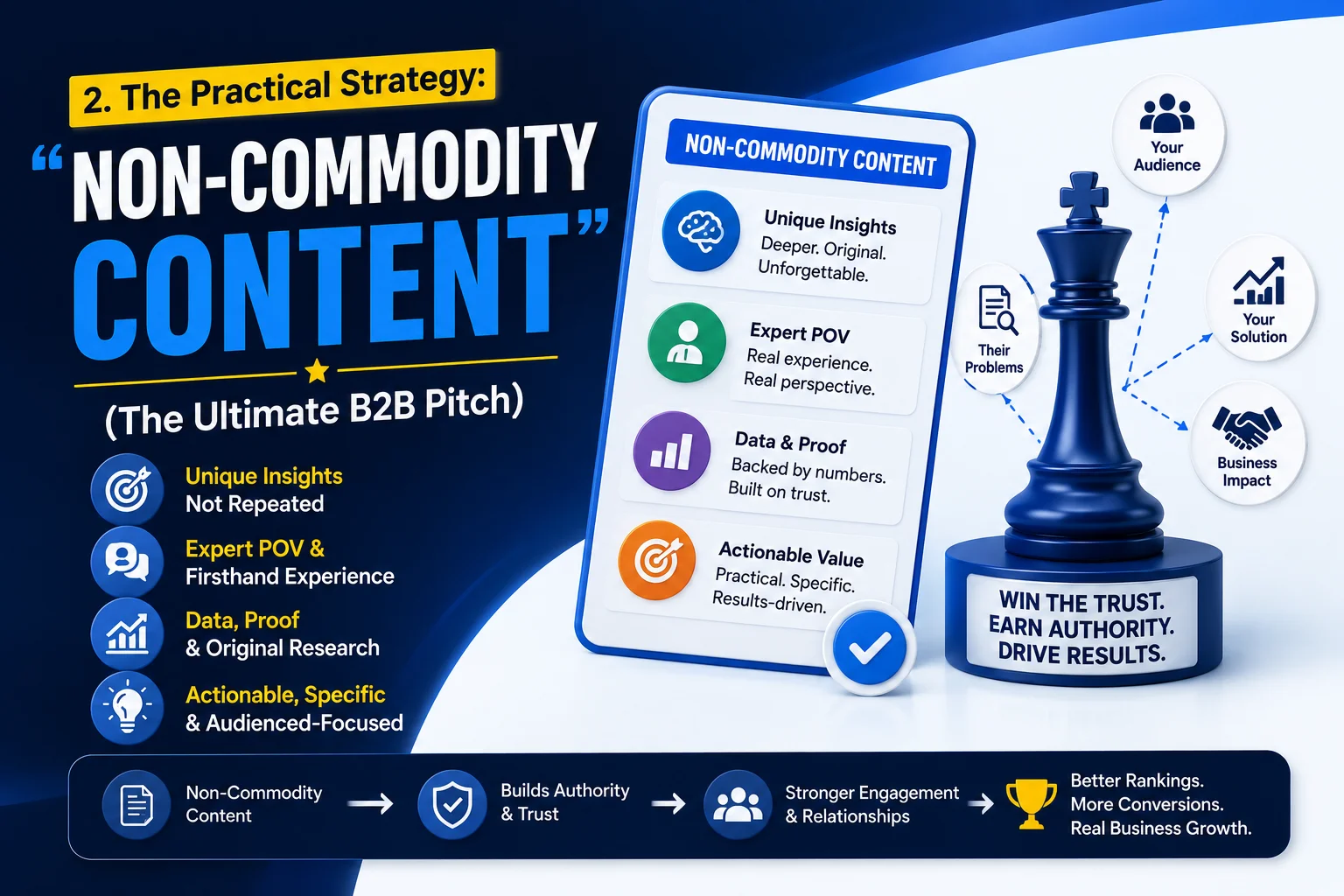
What do you mean by the non-commodity ? Every content writer write the content in a form of Commodity. Which are easily available in the internet. For example : Many content write the on this way. such as “What are 5 features of marketing”. which is a very very basic and normal. It can be found everywhere. AI also search for the unique and non-commodity content. Which as instead of the what are 5 features of marketing, what we have try to write is this – “What Launching a Digital Marketing Engine Taught Me About the 5 Real Pillars of Marketing” . This content are the unique and. a non-commodity.
Non-commodity means, Producing helpful, trustworthy, and people-focused content. Make sure your non-commodity content is trustworthy and helpful to your readers. usually offers readers little original insight and is frequently based on common knowledge that could come from anyone. On the other hand, non-commodity content (like “Why We Waived the Inspection & Saved Money: A Look Inside the Sewer Line”) offers distinct expert or experienced perspectives that transcend the ordinary and common knowledge
3.Focus on what users want. Skip the over-engineering

Google’s scaled content abuse spam policy is violated when content is created primarily to manipulate rankings or generative AI responses in Google Search, despite the temptation to create distinct content for every possible variation of how people might search (e.g., by focusing on other queries that people have asked, or fan-out queries). Additionally, a large number of pages does not improve a website’s quality or make it more user-relevant, so this is an ineffective long-term strategy. Even when there isn’t a perfect match between the query and the main content of the page, Google’s AI systems have further developed and enhanced our capacity to comprehend the relevance of pages.
4. You have to add high-quality images and video

When conducting internet searches, a lot of people value discovering pictures and videos. Similar to Google Search as a whole, our generative AI search capabilities can bring in pertinent photos and videos, giving your website more chances to show up outside of web page links. Look for ways to include relevant, high-quality images and videos on your pages to complement your textual content when it makes sense. You are already optimizing for generative AI search if you adhere to our video SEO guidelines and image SEO best practices.
5. Your Technical Structure should be clear

Google AI systems’ access to your data is still largely dependent on how Google Search locates and evaluates your pages. Technical clarity guarantees that your content is prepared for indexing and discovery, and all current technical SEO best practices are still valuable, such as:
Fulfill the technical requirements of the search
A page must be indexed and meet the technical requirements of Google Search in order to be displayed in generative AI features.
Observe best practices for crawling
As Google Search generative AI models use publicly accessible, crawlable content to learn patterns and provide pertinent, grounded responses, make sure your content is crawlable to optimize your site’s visibility in generative AI search features. Check out our crawl budget optimization guide for very large and often updated websites.
Prioritize human readability over flawless code when it comes to semantic HTML
It’s generally a good idea to try to use semantic HTML whenever possible because it makes it easier for other types of users, like screen readers, to parse and navigate your web page, even though it’s not necessary to have perfectly semantic HTML (the web in general is not valid HTML, and Google can understand it).
Make sure you adhere to JavaScript SEO best practices if you use JavaScript
As long as JavaScript content isn’t prohibited, Google can process it. Nevertheless, it is typically more difficult to work on SEO for websites that employ JavaScript frameworks than for other types of websites. Be sure you adhere to the standard JavaScript SEO best practices.
Make the page experience enjoyable
for people who come to your website. This entails lowering latency, making it simple for users to discern your primary content from other parts on the screen, and making sure your website looks well on all devices.
Cut down on redundant stuff
Duplicate content can negatively impact user experience, and search engines may waste energy crawling irrelevant URLs. Try to cut it down if you have time.

Hi my name is Sanjivan, my nickname is Sanji. Business student who spends way too much time on the internet but make it productive.
I write about business, tech, AI, and marketing the stuff that's actually changing how the world works.
No fluff. No "guru" energy. Just real thoughts from someone still figuring it out. 😄


